
By FencingWise Editorial Team · Updated 17 September 2026.
Make the inspection safe before taking measurements
Keep people and vehicles away from an unstable leaf. Do not remove a hinge or loosen supporting hardware while the leaf is unsupported. Powered gates should be isolated and handled by competent personnel using the applicable procedure.
HSE explains that gate safety depends on the assembled system and its ongoing condition. Its maintenance guidance includes isolation where necessary. A forceful test of a damaged gate is not an appropriate diagnostic method.
If the post is visibly fractured, the leaf is partly detached or a sliding gate may derail, stop normal use and arrange a controlled repair. The measurement sequence below is for a gate that has been made safe to inspect.
Record where in the travel the problem appears
A swing gate that clears the ground when closed but touches it halfway open suggests a different investigation from one whose latch edge has dropped in every position.
Mark the contact location and operating position. Photograph scrape marks before cleaning them away. Note whether the problem began after impact, resurfacing, a storm, hardware replacement or gradual wear.
For a sliding gate, record whether resistance occurs at the same ground location or at the same part of the leaf. A repeating problem at a rail joint points toward a different cause from continuous rubbing at a guide.
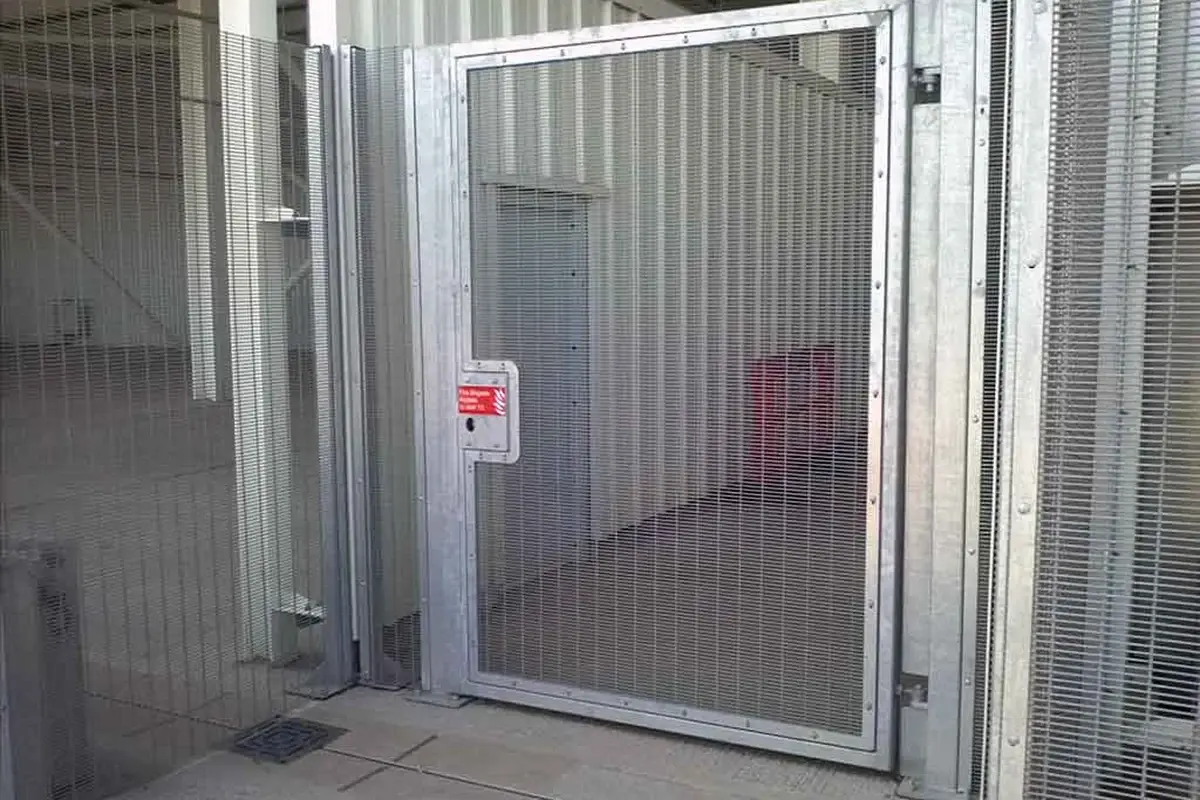
Take a gap map
Measure the hinge-side and latch-side gaps at the top and bottom, plus the bottom clearance at defined operating positions. Compare with the handover record if one exists.
An illustrative set of observations might be:
| Measurement | Handover | Current |
|---|---|---|
| Bottom clearance at hinge end, closed | 50 mm | 49 mm |
| Bottom clearance at latch end, closed | 50 mm | 31 mm |
| Upper latch-side gap | 20 mm | 32 mm |
| Lower latch-side gap | 20 mm | 21 mm |
The 19 mm reduction at the latch-end bottom warrants investigation, but these readings alone do not prove hinge wear. They show a changed relationship between the leaf and its surroundings.
Use the same measuring points and leaf position on each visit. Comparing measurements taken with the gate partly open to closed-position dimensions can create a false trend.
Check post movement independently
Measure post alignment from a suitable datum, using an appropriate level or survey instrument. Also inspect the base, surrounding concrete or ground and any visible movement at connections.
If a post has a horizontal offset of 12 mm over 2,000 mm height, its approximate inclination is arctan(12 ÷ 2,000) = 0.344 degrees. This numerical description is more useful than “slightly leaning”, but it is not an acceptance limit.
Record direction as well as magnitude. A post leaning along the fence line affects the gate differently from one leaning perpendicular to it. If the supporting structure is moving, adjusting the hinge may temporarily improve the gap while leaving the underlying fault active.
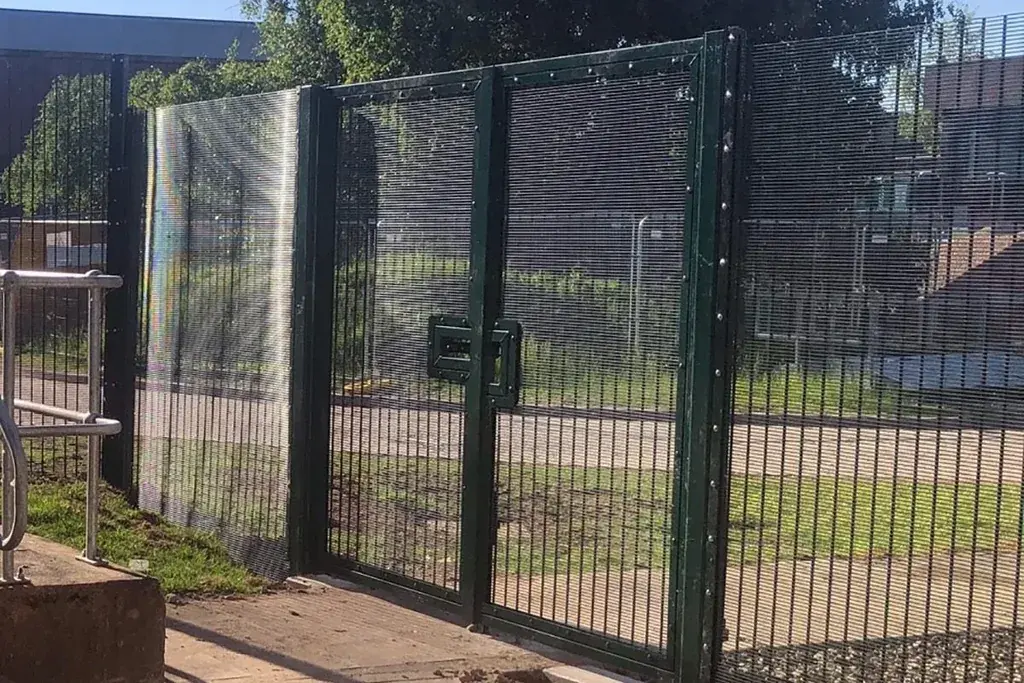
Examine frame geometry and hinge condition
Measure the frame's corresponding diagonals using clearly defined corner references. For an ideal rectangular 2,000 × 1,800 mm frame, each diagonal is approximately 2,690.7 mm.
Suppose actual readings are 2,692 mm and 2,706 mm. The 14 mm difference indicates a geometry discrepancy requiring investigation; it does not by itself identify its cause or provide a universal rejection threshold. Compare with the fabrication drawing and inspection method.
Inspect hinge pins, bearings, attachments and available adjustment. Look for movement between parts that should remain fixed. Record wear or looseness without dismantling unsupported components.
Equal diagonals do not prove the frame is flat, and a square frame does not prove the post is stable. Keep those checks separate.
Choose the repair from the evidence
| Finding | Appropriate direction |
|---|---|
| Debris or local ground interference | Clear or correct the obstruction using the approved surface arrangement |
| Worn replaceable hinge component | Replace with a compatible part, then realign |
| Post or foundation movement | Resolve the support condition before leaf adjustment |
| Distorted frame or failed weld | Obtain a repair or replacement disposition |
| Misaligned sliding track or guide | Correct the relevant support and alignment |
| Powered gate protective fault | Keep out of service until competent diagnosis and recommissioning |
Avoid increasing motor force, grinding away structural material or enlarging holes simply to restore movement. Those actions can change strength, retention or safe operation.
Repeat the original measurements after repair
Use the same gap map, datum and operating positions. Check the full travel, latch engagement, stops and retention. For powered gates, complete the required safety tests before returning the installation to use.
Record the replaced parts and any setting changes. A follow-up measurement can then establish whether the correction remains stable. If the same gap begins changing again, the record will show that the problem is recurring rather than merely reporting another difficult-to-close gate.