
Start with requirements that cannot be traded away
List mandatory conditions before assigning scores. These may include a specified system approval, containment duty, permitted geometry, material requirement or compatibility with existing posts. Each condition needs a clear basis and a pass, fail or unresolved result.
An unresolved mandatory item is not a partial pass. Keep that option outside the final selection until the missing evidence is supplied. This prevents an attractive cost or visual score from concealing a technical gap.

For example, if a tender requires a certified system, ordinary 358 mesh does not qualify solely because it has a close aperture. See the difference between anti-climb mesh and certification before including that option in a compliant comparison.
Compare construction families by the problem they solve
| Family | Useful reason to investigate it | Question that must still be answered |
|---|---|---|
| Close-aperture security mesh | Restricted openings and a defined security boundary | Does the complete assembly meet the required evidence and geometry? |
| Twin-wire welded mesh | Rigid panel construction with paired horizontal wires | Which wire configuration and support arrangement fit the duty? |
| Profiled welded mesh | Formed panel geometry and a distinct visual elevation | Are profile depth, connections and ground transitions suitable? |
| Chain link | Woven roll construction and a tensioned installation method | Are posts, braces, terminations and edge details fully specified? |
| Sports rebound system | Repeated low-level ball contact | Is the lower zone and its connection designed for the intended use? |
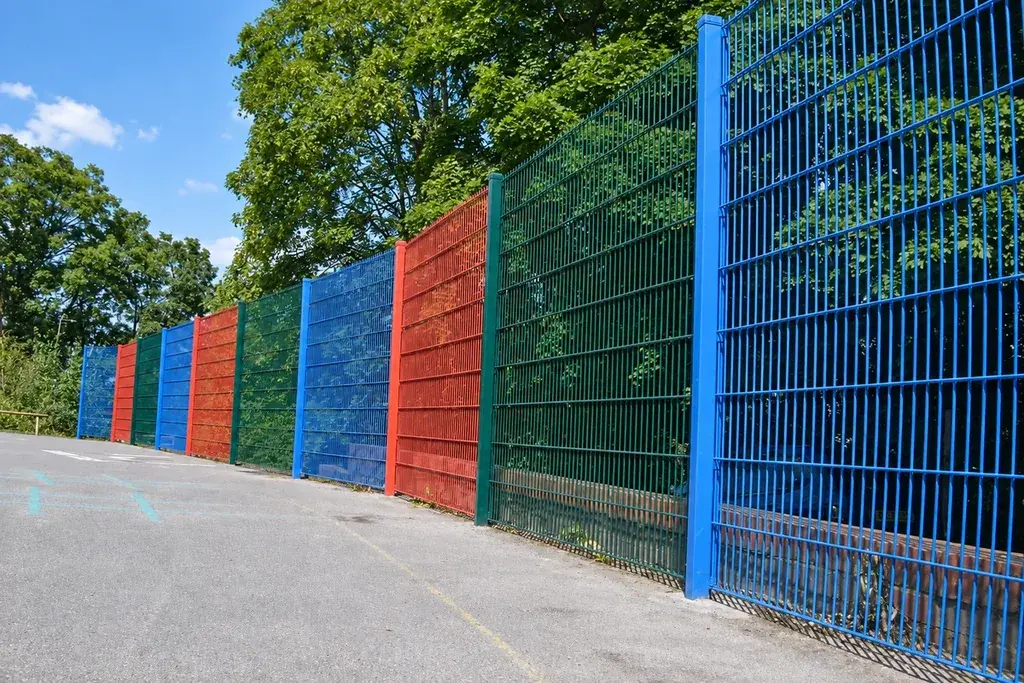
These are investigation routes, not universal performance rankings. Products within a family can differ substantially, so compare the actual offered assembly once the family has been shortlisted.
Use weighted preferences only after qualification
Suppose three hypothetical options have passed all mandatory checks for one ordinary boundary project. The buyer then assigns weights of 40% to fit with the maintenance system, 35% to total supplied cost and 25% to the required appearance. Scores run from 1 to 5, with 5 best, under written scoring definitions.
| Option | Maintenance fit | Cost | Appearance | Weighted score |
|---|---|---|---|---|
| A | 5 | 3 | 4 | 4.05 |
| B | 3 | 5 | 4 | 3.95 |
| C | 4 | 4 | 3 | 3.75 |
For A, the result is 5 × 0.40 + 3 × 0.35 + 4 × 0.25 = 4.05. The margin over B is only 0.10. These are invented scores, not ratings of any FencingWise product or mesh family.
If cost weight rises to 45% and maintenance falls to 30%, with appearance still 25%, A scores 3.85 and B scores 4.15. The decision reverses. That tells the buyer to resolve the importance of maintenance compatibility instead of presenting the first ranking as an objective truth.
Define evidence behind each score
Cost should come from equivalent quotations covering posts, fixings, gates and delivery scope. Maintenance fit should refer to actual spare references, access and replacement work. Appearance should use an agreed sample, elevation or site review rather than an unsupported adjective.
Keep the evidence date and product revision alongside the score. A revised coating or panel width can change both cost and compatibility. The matrix should be updated when the proposal changes, not retained as a record of a superseded option.
Avoid excessive decimal precision. A calculated 4.05 does not make subjective input scores accurate to two decimal places. Use the calculation to expose assumptions and close decisions, then document the practical reason for the choice.
Test the awkward parts of the layout
Before selecting, review a corner, a change of level, a gate junction and a replacement bay. Standard straight-run samples can hide the costs or limitations of these details. Ask whether the chosen family preserves the intended lower-edge condition and supports the required gate interface.

A mixed site may need more than one system reference. It can be sensible to use a different construction for a sports rebound zone than for a service-yard boundary, provided the transition is designed and documented.
Finish with the selected assembly, the rejected alternatives and the reason each was rejected. The product collections provide routes to the actual ranges; the matrix supplies the decision logic that a catalogue cannot provide on its own.