
By FencingWise Editorial Team · Updated 17 September 2026.
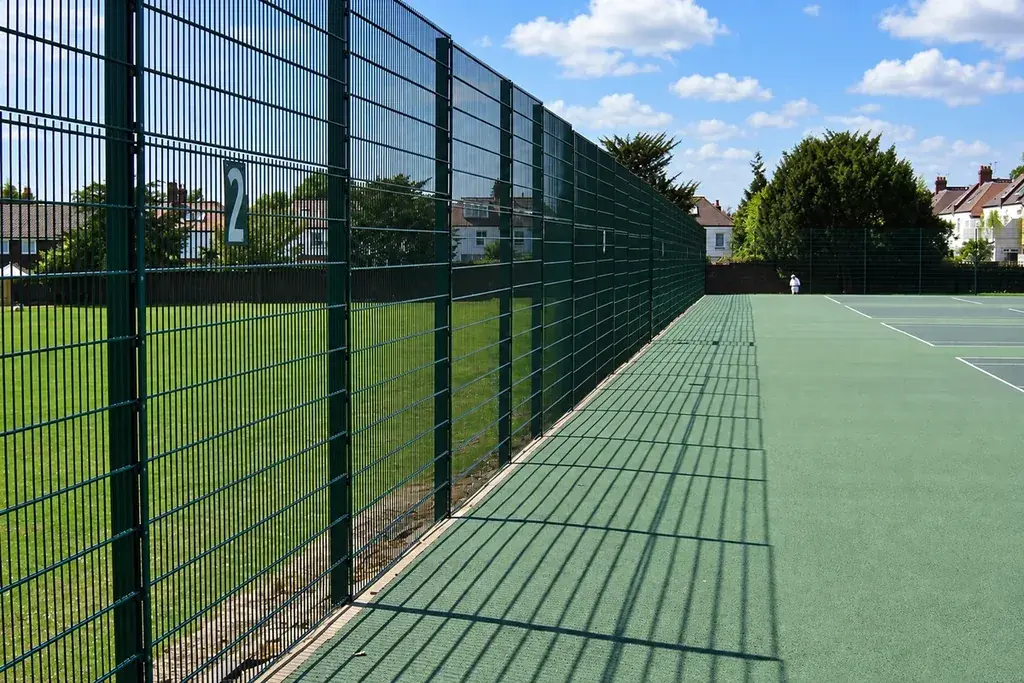
Distinguish the marked court from its surrounding space
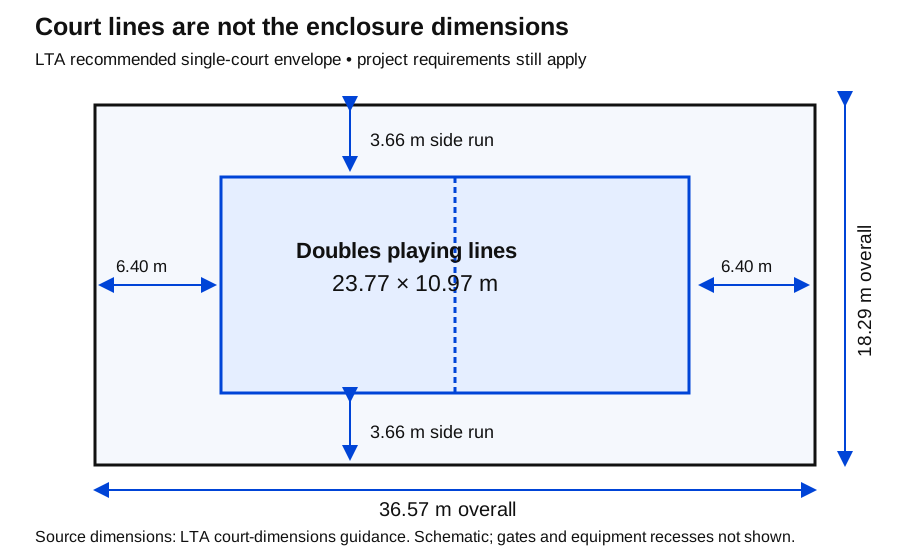
The LTA's published dimensions give a doubles court of 23.77 × 10.97 m and a recommended single-court envelope of 36.57 × 18.29 m. The latter includes 6.40 m run-backs and 3.66 m side runs.
These are LTA recommendations for the stated context, not a replacement for the requirements of every competition, accessibility arrangement or local project. Check the applicable facility brief and drawing references.
The difference can be verified directly:
(36.57 −23.77) ÷ 2 = 6.40 m behind each baseline.
(18.29 −10.97) ÷ 2 = 3.66 m beside each doubles sideline.
Do not measure the enclosure to the outside face of a projecting post if that would leave less usable space inside.
Calculate the fence line from the chosen envelope
For a simple rectangular fence line following the recommended envelope above, the gross perimeter is:
2 × (36.57 + 18.29) = 109.72 m.
If two 1.20 m openings are included, the fixed fence length is 109.72 −2.40 = 107.32 m before accounting for exact post and panel geometry.
This quantity example assumes the fence line coincides with that rectangle and does not add equipment recesses, angled corners or access lobbies. Those features should be measured separately.
For multiple courts, use the applicable combined layout. Doubling the width of a standalone enclosure can overstate or misallocate the shared space between courts.

Read the mesh dimension convention
A welded rectangular mesh and a woven diamond mesh describe openings differently. Record the clear opening, pitch or other defined measurement instead of assuming all quoted “mesh sizes” are directly comparable.
Confirm the proposed mesh pattern against the tennis-court requirements and the actual panel drawing. A nominal pattern from another fence system is not a FencingWise catalogue value.
The ITF's 2026 technical booklet specifies 6.54–6.86 cm, or 65.4–68.6 mm, for the diameter of Type 1 and Type 2 balls. This gives useful scale, but a static ball-diameter comparison does not by itself prove dynamic retention. Balls deform, mesh can move, and joints or gates can have larger openings than the nominal mesh.
For a club using junior or specialised balls, identify those separately rather than assuming one ball specification covers all sessions.
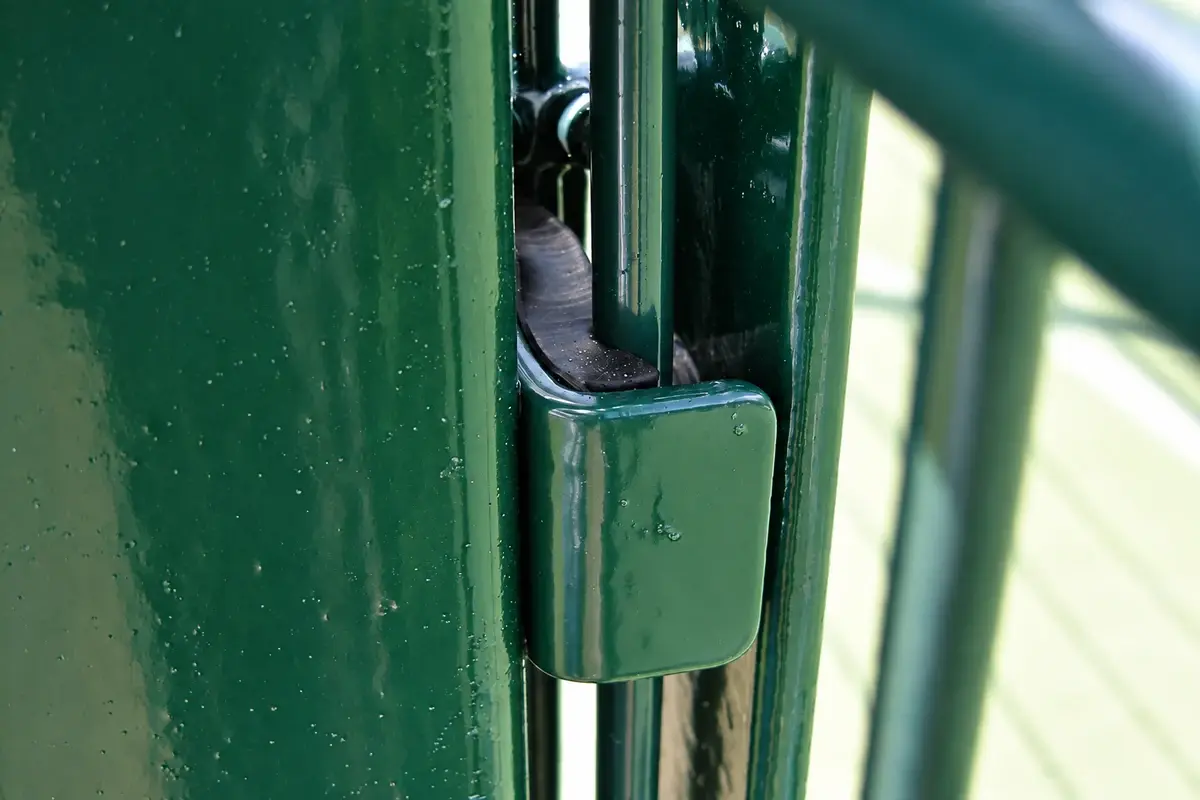
Check the enclosure where balls actually strike
| Location | Detail to examine | Why it matters |
|---|---|---|
| Behind baselines | Mesh and connection behaviour under repeated impact | Frequently contacted area |
| Panel joints | Clear opening and movement at the post | Local gap can exceed the mesh opening |
| Gate frames | Infill, perimeter gaps and threshold | Interrupts the continuous fence |
| Bottom edge | Finished clearance and surface transitions | Ground-level ball escape |
| Corners | Overlap and exposed projections | Different geometry from straight runs |
Use the actual assembled detail for assessment. A sample mesh square does not reproduce a post joint, a gate bottom or a flexible edge.
Where ball retention is a contractual performance requirement, establish a suitable test or acceptance method for the system and the intended ball. Avoid absolute promises based only on a catalogue drawing.
Position gates around play and maintenance
Draw the gate in both closed and open positions. Keep its movement and projecting hardware clear of the required playing space. Coordinate access for users, mobility equipment and court-maintenance machinery.
A low threshold may help movement but must also deal with drainage and ball retention. Show the final surface level through the entrance, including any transition between the court and external paving.
If divider netting is used between courts, identify its storage and fixing arrangement. A rolled or folded divider should not create an obstruction in the side run when removed from use.
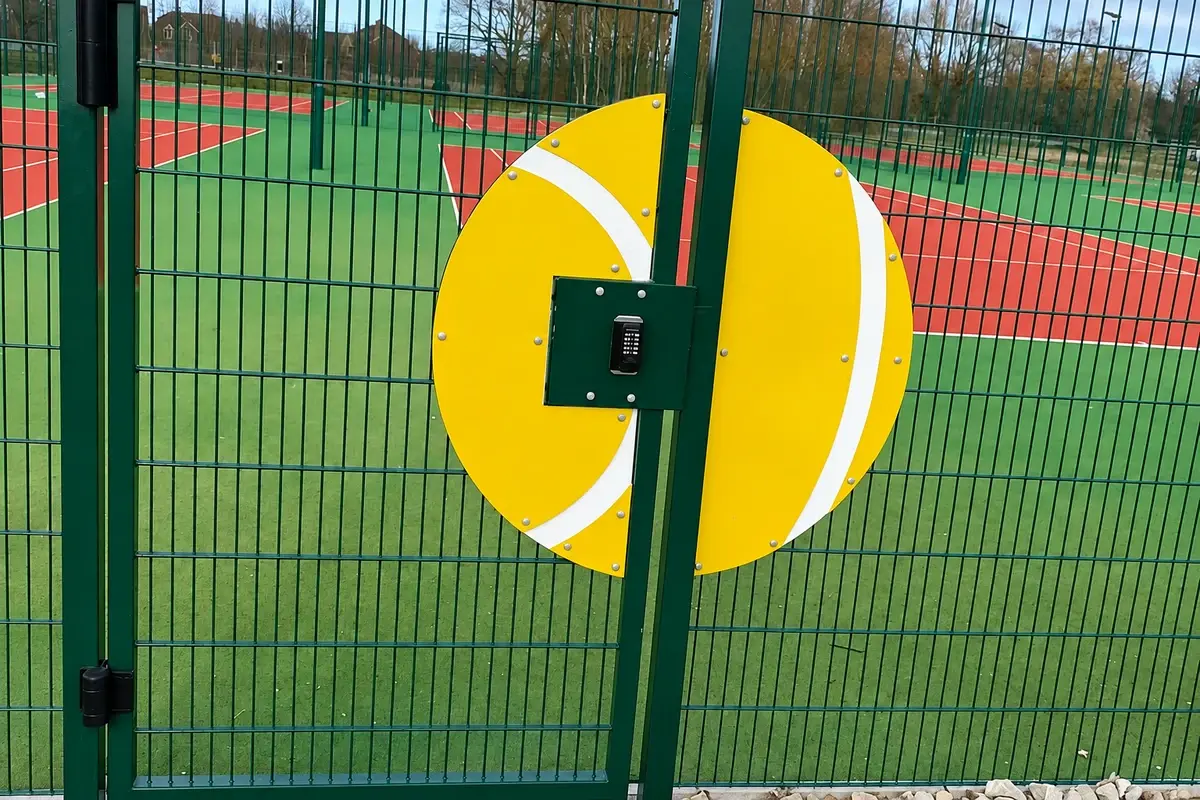
Review additions that change the fence duty
Windscreens, privacy sheets and advertising banners can change the loading and visibility of an otherwise open fence. Their size and position should be reviewed with the support design before installation.
For an illustrative screen 12 m long × 2 m high, the gross face area is 24 m². That number is useful for the modification record, but the structural effect depends on permeability, pressure and the actual support arrangement.
Keep the court's mesh, gate and attachment details together in the maintenance file. The operator can then replace damaged components without changing the original clearances or adding an unassessed screen. Use the sports-fence inspection checklist to maintain that baseline through daily use.