
Name the party responsible for the complete assembly
The HSE powered-gate safety guidance emphasises the way components work together in their actual environment and the need for a suitable risk assessment. Component specifications alone cannot establish the safety of the final installation.
For procurement, identify who designs and assesses the complete gate, who installs it, who commissions it and who hands it over to the operator. One organisation may perform several roles, but the roles should still be explicit. FencingWise's fence and gate material supply should not be mistaken for a promise to undertake powered-gate system design or commissioning.
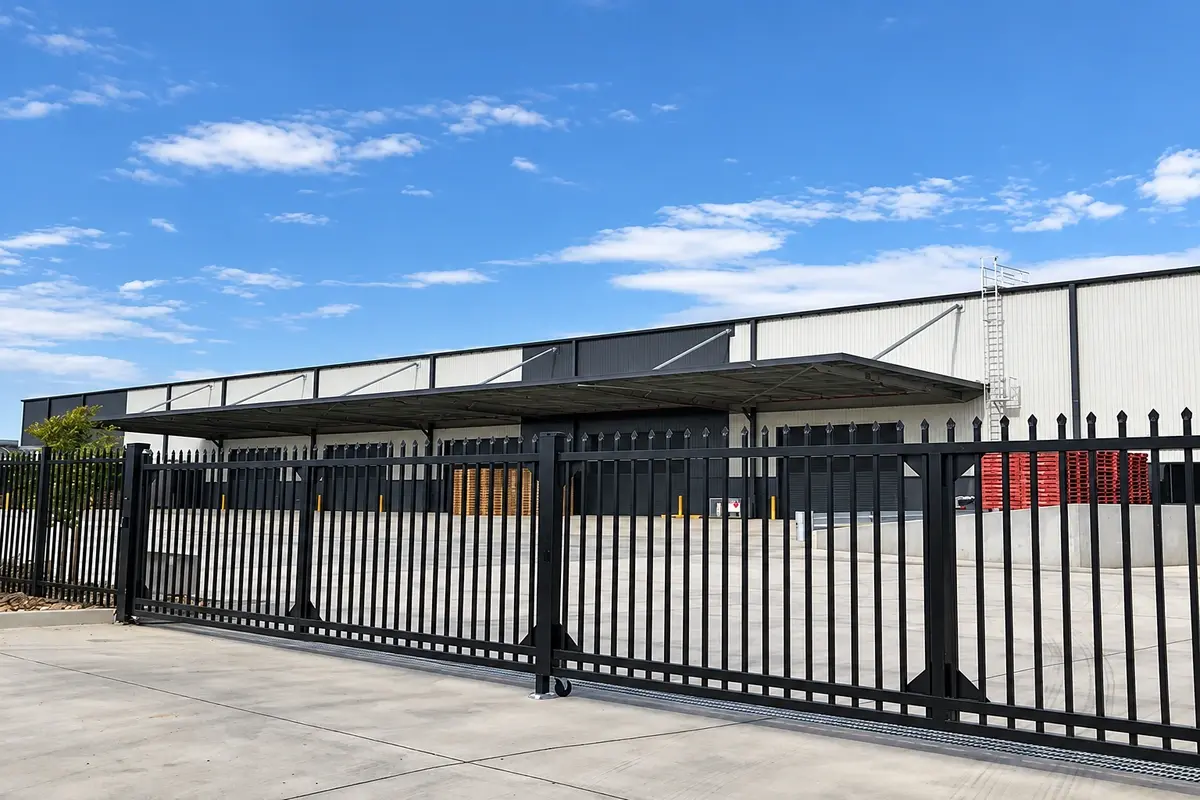
Create an interface register
| Interface | Input needed by the mechanical supplier | Decision owner to identify |
|---|---|---|
| Drive attachment | Approved bracket location, geometry and loads | Gate system designer |
| Power and controls | Cable routes, enclosure positions and isolation arrangements | Electrical and controls specialists |
| Protective devices | Required positions and mounting details | Responsible gate safety designer |
| Access control | Operating modes and command interface | Access-control provider with the gate integrator |
| Civil support | Foundation, track or support details | Civil or structural designer |
| Emergency arrangements | Agreed release and access procedure | Integrator and site operator |
| Handover | Tests, instructions and maintenance responsibilities | Commissioning party and operator |
Each row should end with an accepted drawing or instruction, not simply a supplier name. The register makes it possible to see which mechanical features cannot yet be fabricated because an interface remains unresolved.
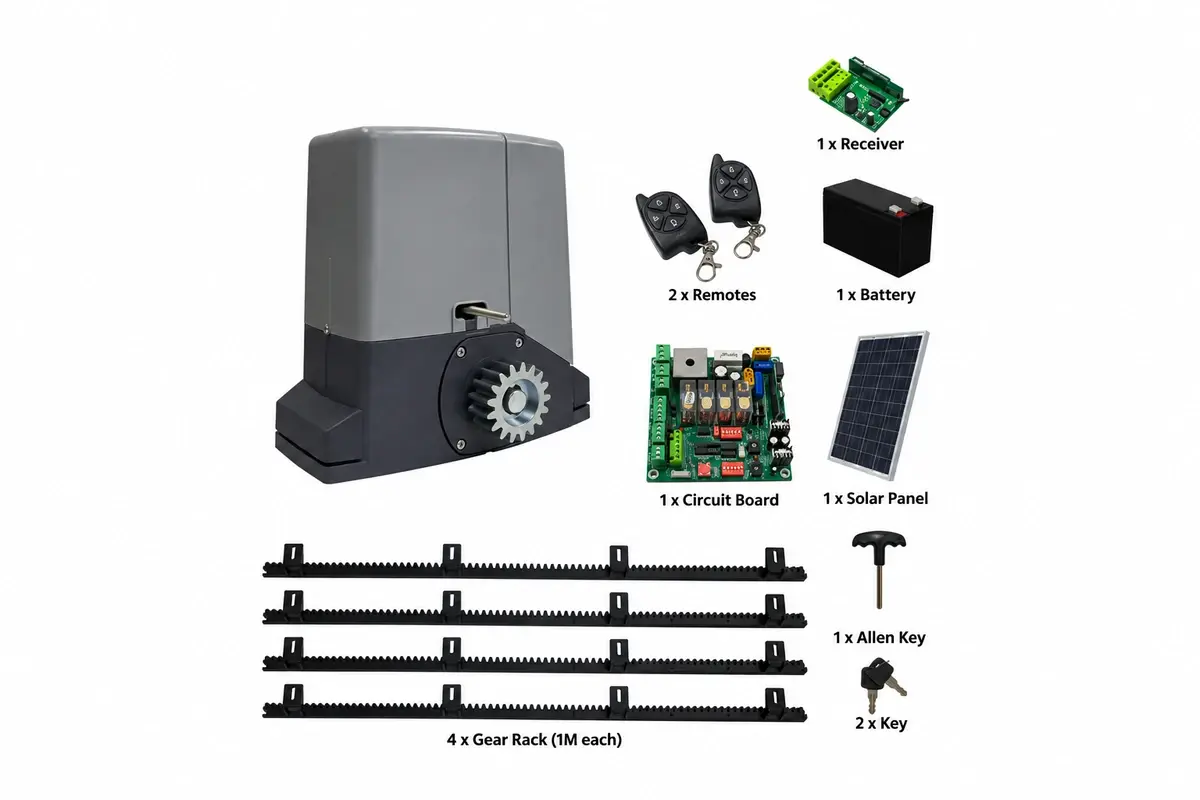
Fix the opening and travel envelope
A sliding gate needs both the required clear opening and space for the moving leaf in its open position. A cantilever arrangement also has support geometry that cannot be inferred from the opening alone. A swinging gate needs its full movement area checked against ground levels and nearby structures.
For illustration, a plan may reserve 6.0 m of clear passage and show an 8.4 m overall moving assembly. Those are separate dimensions. The 2.4 m difference is not automatically usable passage or a universally suitable counterbalance length; it belongs to that specific approved gate design.
Carry the actual dimensions into the foundation, service and fence drawings. A late reduction in available run-back space can invalidate the selected mechanism even when the clear opening requirement has not changed.
Keep operating modes visible
List normal entry, exit, authorised maintenance and emergency arrangements at a functional level. Identify who may operate the gate and how the surrounding public or staff can encounter it. The responsible specialist uses that information in the risk assessment and control design.
Do not specify a single photocell or force setting as a complete safety solution. Crushing, trapping, shearing, uncontrolled movement and other hazards need assessment across the whole installation. Acceptance testing and settings must follow the applicable design and instructions, with suitable instruments and competent personnel.
Any example timing used for traffic planning must remain separate from safety acceptance. A fast opening time may improve a queue calculation but does not justify unsafe motion or a bypassed protective function.
Use a simple closure tracker
Suppose the interface register has 12 rows: 8 accepted, 3 awaiting revised drawings and 1 awaiting the responsible owner's decision. The arithmetic is 8 ÷ 12 = 66.7% accepted, but that percentage is not a readiness score. The remaining electrical or safety interface may prevent the entire installation from proceeding.
Track each row as open, submitted, accepted or superseded. Record the revision and reviewer. Do not change open to accepted merely because material has already been ordered or a delivery date is approaching.
Require a complete handover package
Before the gate enters service, the responsible providers should complete the required commissioning, conformity and operating documentation for the applicable jurisdiction and installation. The HSE basics page describes the importance of proper design, competent installation, instructions and maintenance.
The operator also needs the asset identity, component references, approved operating arrangements, maintenance requirements and fault-reporting route. Demonstrations should cover the agreed user functions and emergency procedure without exposing people to moving machinery.
A sound procurement record makes the boundary of each supply clear while assigning responsibility for the joined-up result. Start with the gate schedule and keep the accepted interface register with every subsequent mechanical or electrical revision.