
By FencingWise Editorial Team · Updated 17 September 2026.
This produces a clearer decision than asking the supplier whether everything is included.
Use the same references in all documents
Begin with the latest layout, component schedule, gate drawings and finish requirements. Identify their revisions on the comparison sheet.
Give the quotation's items the corresponding references. If a supplier combines several parts into one price, ask for the contents of that assembly. You do not necessarily need separate prices for every washer, but you do need to know whether the washer is present.
Where the supplier uses its own part code, retain both codes. That cross-reference makes it easier to follow the item through the order and packing list.

Check the physical package first
Work through the material categories in the order they connect:
- Panels by actual size and type.
- Posts by position and mounting arrangement.
- Panel-to-post connections and complete fastener contents.
- Gates, their supports and operating hardware.
- Caps, special terminations and other specified accessories.
- Finish, packing, inspection and required documents.
At each stage, check quantity and unit. “20 pairs”, “20 pieces” and “20 sets” can represent different physical totals. Define the contents of a set before treating its quantity as comparable.
Classify a difference instead of calling everything an omission
| Status | Meaning | Action |
|---|---|---|
| Included | Defined item and quantity are in the offer | Retain the reference |
| Excluded | Required item is expressly outside the offer | Add a priced scope or identify another supplier |
| Substituted | A different specification is offered | Review technical acceptability before price comparison |
| Unresolved | The wording does not establish inclusion | Obtain a written clarification |
| Duplicate | The same requirement appears in two included lines | Check whether both are genuinely needed |
A thicker wire, different post section or alternative coating is a substitution, not merely another price for the same item. Keep it visible even when the supplier describes the alternative as an upgrade.
Calculate the effect of omitted scope
Consider two fictional quotations for the same defined fence package. Offer A totals £5,000, but excludes gate hardware and specified inspection. Offer B totals £5,250 and includes both.
For the example, the agreed missing scopes for A cost £180 for hardware and £120 for inspection.
The normalised comparison becomes:
Offer A: £5,000 + £180 + £120 = £5,300.
Offer B: £5,250.
Offer B is £50 lower on the assumed equal scope, although its original headline was £250 higher. These amounts are invented to demonstrate the method; they are not current prices.
If the missing costs are not yet known, do not enter zero. Mark the total as incomplete and obtain the information needed for the comparison.
Check connection sets for hidden quantity differences
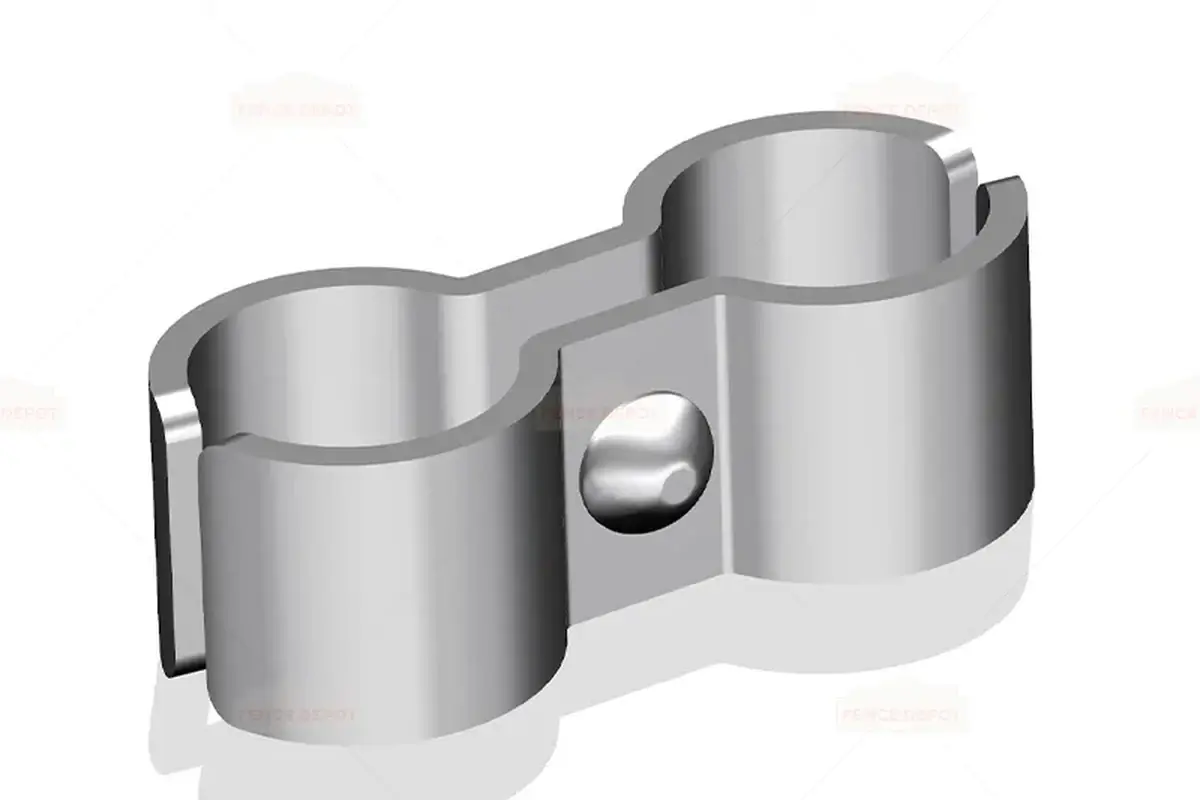
Assume a drawing requires 80 complete connections, each comprising one clamp, one bolt, one nut and two washers.
An offer listing 80 clamps and 80 bolts still needs the nuts and washers resolved. If the supplier's “bolt kit” already includes one nut and two washers, adding them again would double-count those contents.
A reconciliation should therefore show either 80 complete identified kits, or the explicit loose quantities: 80 clamps, 80 bolts, 80 nuts and 160 washers.
The accessory-counting guide provides the connection-based method. Apply it to the quoted units rather than assuming a supplier's kit definition.

Pay special attention to interfaces between suppliers
Omissions often occur where one party expects another to supply an item. Examples include anchors for a base plate, receivers for a gate latch, or brackets connecting fence panels to a separately supplied gate post.
Create a responsibility column for each interface. State who supplies the part and which drawing defines it. A line that says “by others” is incomplete if nobody in the procurement package owns it.
Do the same for specialist design, foundations and installation. A material quotation should not be interpreted as including those services unless the agreed scope says so.
Review commercial scope without changing technical scope silently
Record the agreed delivery basis, destination, currency, validity, payment stages and schedule assumptions as written in the offer. If specialist interpretation of contract or shipping terms is needed, obtain it for that actual transaction.
For comparison, the immediate task is to identify differences. Do not add a freight estimate to one offer while comparing it with another on a different destination basis. Likewise, an optional inspection or packing arrangement should be included only if it forms part of the common requested package.
The cost-drivers article helps distinguish a scope adjustment from a change in the product itself.
Close clarifications in a revised order record
Summarise each resolved point with the agreed wording and affected line. Request a revised quotation or another controlled record that incorporates the decisions.
Do not rely on a collection of informal messages that contradict the final item schedule. The manufacturing and packing teams need one consistent scope.
Before acceptance, repeat the four-way check: drawing, BOM, quotation and clarification record. A completed review identifies all required items, visible substitutions, remaining exclusions and the resulting comparable total. That is a stronger basis for purchase than a general assurance that the fence is supplied complete.