
Establish jurisdiction before using a dimension
Pool-barrier requirements differ between countries and local authorities. Residential guidance should not be assumed to govern a commercial leisure facility. Ask the project designer or relevant authority to identify the applicable document, edition, approval process and responsibility for acceptance.
As a clearly limited example, the US Consumer Product Safety Commission's residential guidance discusses a barrier at least 48 inches high. Forty-eight inches converts to 1,219.2 mm; it should not be rounded down to 1,200 mm and then treated as equivalent. This example is not a universal requirement or a claim of product compliance. CPSC residential pool barrier guidance.
Record the governing measurement method as well as the number. A height measured from unfinished soil can change after paving or landscaping.
Identify every route into the pool area
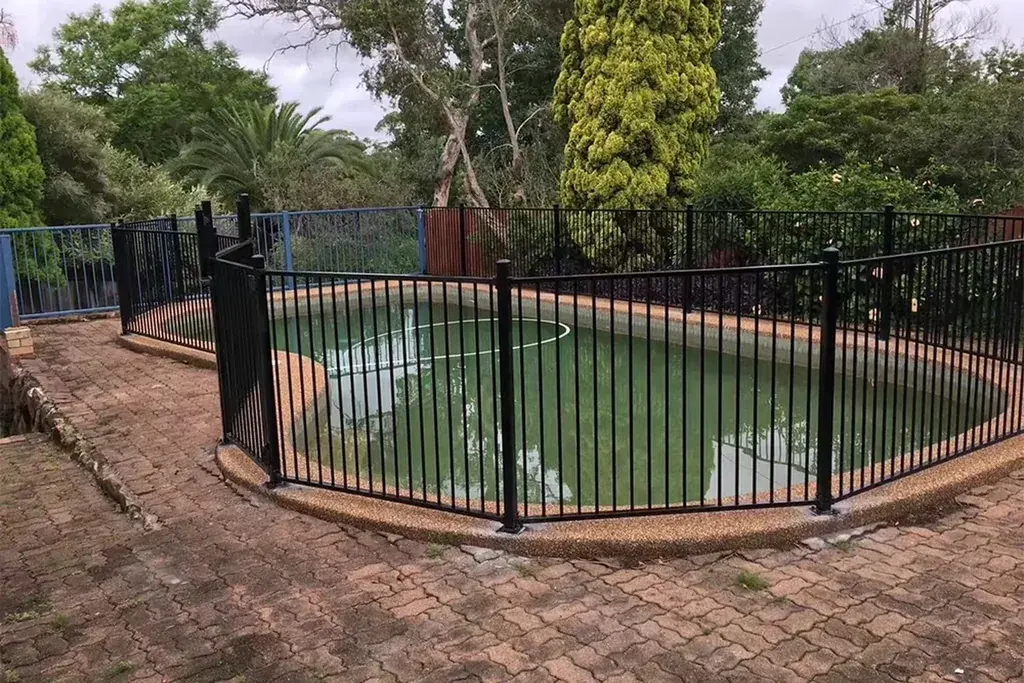
Draw the complete enclosure, including doors from buildings, gates, level changes and junctions with existing walls. A compliant-looking run can be bypassed through an untreated opening elsewhere. Mark furniture, planting and equipment that could alter the accessibility of the barrier.
| Interface | Procurement information |
|---|---|
| Fixed panels | Finished height, openings and support arrangement |
| Pedestrian gate | Clear opening, swing, closing and latching arrangement |
| Wall junction | Gap, connection and adjacent standing surfaces |
| Sloping ground | Maximum openings over the actual finished profile |
| Maintenance access | Controlled opening and restoration procedure |
Give each opening an identity on the schedule. A gate omitted from the quotation is not a minor accessory to be selected after the panels arrive.
Ask for evidence covering the actual configuration
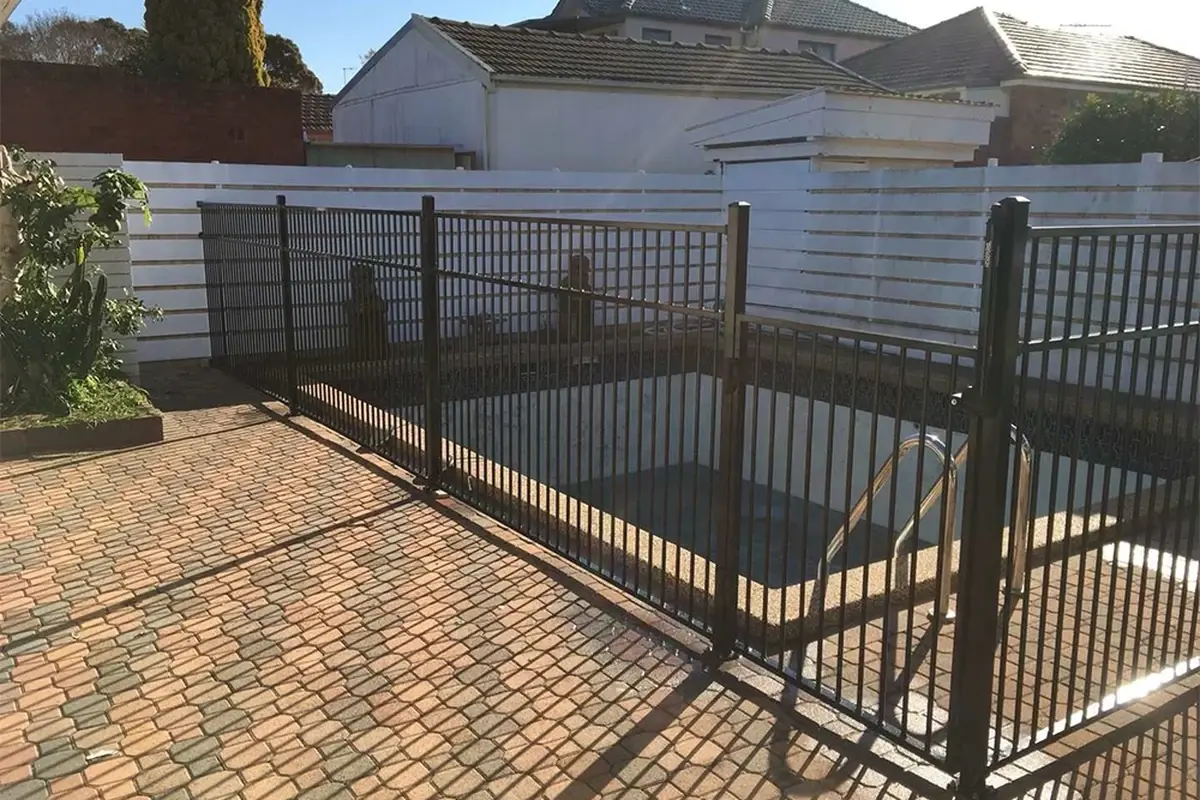
Check the product reference, panel dimensions, posts, connections and gate hardware against the submitted report or assessment. A test of one height or support spacing should not be silently extended to a different arrangement.
A material certificate alone does not establish barrier performance. Likewise, a self-closing hinge description does not demonstrate that the assembled gate will close and latch throughout its intended operation. Confirm the assessment and commissioning method with the responsible specialist.
If substitutions are proposed, identify them before production. A different latch, hinge, infill or post can change the assessment even when the visible colour and overall height remain unchanged.
Use a dimensional review with explicit limits
For an illustrative project check, suppose the approved drawing requires a dimension to remain at or below 100 mm and a measured opening is 103 mm. The difference is 3 mm above that project limit. An average of several smaller openings cannot cancel it. This is an example of checking an agreed limit, not a statement that 100 mm is the applicable pool-barrier rule.
List each required measurement, its datum, the accepted limit and the tool or method. Include the positions most affected by ground changes and moving hardware. Do not replace specified probe tests with a tape-measure estimate.
Control substitutions at the pool gate
When a closer, latch or hinge is replaced, compare the replacement with the accepted gate configuration and the applicable assessment. Matching the mounting holes does not establish equivalent operation. The reviewer may need information about the complete gate, its mass, geometry and operating conditions rather than a hardware catalogue page alone.
Keep maintenance staff informed that a gate fault is a barrier issue, not merely an inconvenience. The operator should follow the established response while the gate is assessed or repaired, and the return-to-service decision should be recorded after the required checks.
Include the final surfacing and adjacent objects in that review. A gate that previously operated correctly can encounter a changed threshold, a new obstruction or a different approach condition. Retaining the accepted layout and hardware identities makes it possible to investigate those changes without reconstructing the original purchase from photographs and broad product names.
Release the order and installation separately
Before manufacture, freeze the approved configuration, drawings and evidence. At installation, verify the finished levels, complete perimeter and gate operation. Construction changes should return to the responsible reviewer where they affect the accepted arrangement.
Retain the inspection and maintenance instructions with the handover records. The owner needs to know how to recognise damage or a closing failure and how to obtain a compatible replacement.
For geometry on uneven ground, see rackable and stepped fencing. For the underlying material description, use PVC and vinyl terminology. Neither guide replaces the pool-specific design and acceptance process.