
By FencingWise Editorial Team · Updated 17 September 2026.
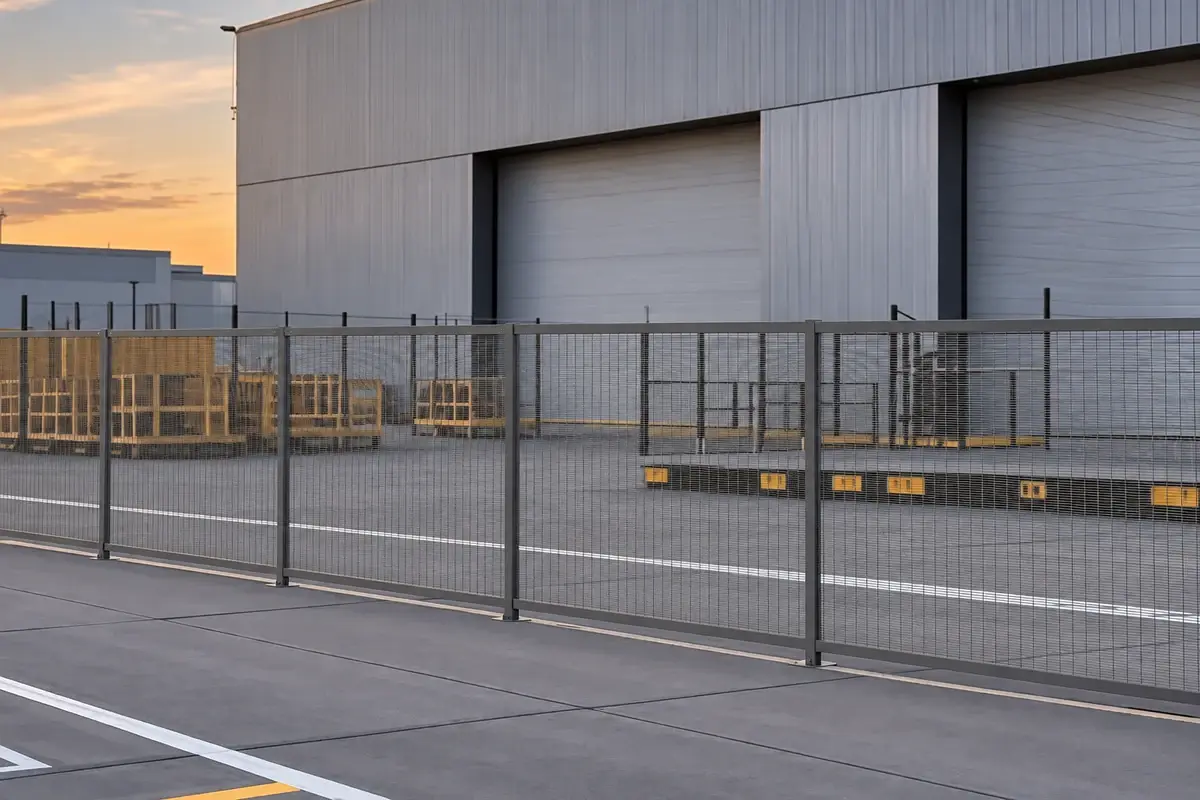
Establish what “double skin” means on the drawing
Ask for a section through the assembly and an elevation showing both layers. Two parallel layers with their wires aligned have a different projected opening from two layers turned through 90 degrees. An offset arrangement introduces another pattern again.
For double-skin fencing, confirm the mesh pattern, relative orientation and attachment of both layers on the system drawing. A second layer does not by itself establish an equivalent or higher security rating.
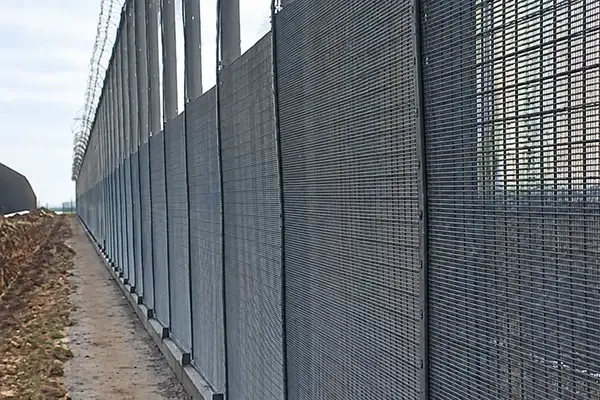
Nominal mesh dimensions also need a stated measurement convention. A centre-to-centre pitch is not the same as a clear opening between finished wires. Coating thickness and the relative position of the two layers affect the latter.
A useful detail therefore identifies:
- The wire directions and dimension convention for each layer.
- Whether layers touch, overlap locally or are separated by spacers.
- The face from which fixing heads and nuts can be accessed.
- How both layers terminate at corners, gates and changes in level.
- Whether the second layer extends over the full fence height.
Compare the assemblies on the same basis
| Item | Single mesh layer | Two mesh layers |
|---|---|---|
| Panel schedule | One panel position per bay and height section | Separate position for each layer |
| Fastening | Secures one mesh assembly to its support | Must secure both layers using the designed load path |
| Inspection access | One mesh face and its joints | Additional interfaces may be concealed |
| View through the fence | Depends on mesh and viewing angle | Also depends on alignment and separation |
| Replacement | Remove the affected panel assembly | Establish which layer can be removed first |
| Supporting structure | Checked for the selected panel and site | Recheck added weight and wind behaviour |
Doubling the number of layers does not establish twice the intrusion delay. Delay depends on a complete configuration and a defined test. Similarly, doubling panel mass does not mean that wind force simply doubles: shielding and aerodynamic interaction need a suitable design basis.
Work out the additional panel material
Consider an illustrative straight run with 20 bays, each using a 2.50 m wide × 2.40 m high mesh panel. Assume the two-skin option has two full-height layers of the same panel, without extra overlaps in this simplified quantity calculation.
One panel has a gross face area of:
2.50 × 2.40 = 6.00 m².
The single-skin order contains 20 panels, or 120 m² of panel face area. The double-skin order contains 40 panels, or 240 m². The fence still encloses the same nominal 50 m run; it has not become 100 m of boundary.
If the estimating mass is assumed to be 8 kg/m², panel material alone would be 960 kg for one layer and 1,920 kg for two. The extra 960 kg excludes posts, brackets, packaging and any difference in the actual manufactured panels. These are estimating assumptions, not supplied weights.
For an option with the second layer only on the bottom 1.20 m, calculate its area separately: 20 × 2.50 × 1.20 = 60 m². The total becomes 180 m², subject to the actual panel divisions and overlaps. A half-height second layer should never be priced or described as a full-height assembly.
Check the places where layers stop
At a gate, the fixed fence can have two skins while the gate leaf has only one. That mismatch deserves a specific decision. It may alter the intended barrier continuity even where the top lines align.
At a corner, each layer can require a different edge overlap. A plan view should show whether a gap appears between the last wire and the post. On stepped ground, check both the exposed bottom opening and the vertical transition between adjacent panels. The bottom-gap survey method explains how to record those positions.
Inspection photographs should include the layer relationship before the closing clamp or second panel conceals it. A photograph of the finished outer face alone cannot establish that the internal arrangement matches the approved section.
Select the simpler arrangement that meets the requirement
Choose a single layer where the approved security requirement can be met by that system and easier viewing, handling or replacement matters. Consider a designed double-skin assembly where a specific threat assessment or verified system requirement calls for it, and where its support structure and gates can accommodate the change.
For procurement, compare a complete single-skin system with a complete double-skin system. Price the additional panels, altered connections, structural revisions, transport weight and installation sequence separately. This makes the cost of the second layer visible without presenting additional steel as proof of additional certified performance.