
List the sports and the objects to contain
Record the intended sports, ball types, level of use and any planned shared use. Identify which activity governs aperture, rebound behaviour and the required containment arrangement. A mesh that retains one ball may not retain a smaller ball used in another activity.
The enclosure layout must also preserve the sport's required playing area and run-offs. Obtain the relevant governing-body and project requirements before locating posts. Our tennis court layout article provides a worked example of separating court markings from the surrounding envelope; its dimensions should not be applied to another sport.
Avoid selecting height from a single photograph. Consider the direction of play, neighbouring roads or properties and the consequences of a ball leaving the site. High-level ball containment needs the responsible designer's assessment rather than a promise based on panel height alone.
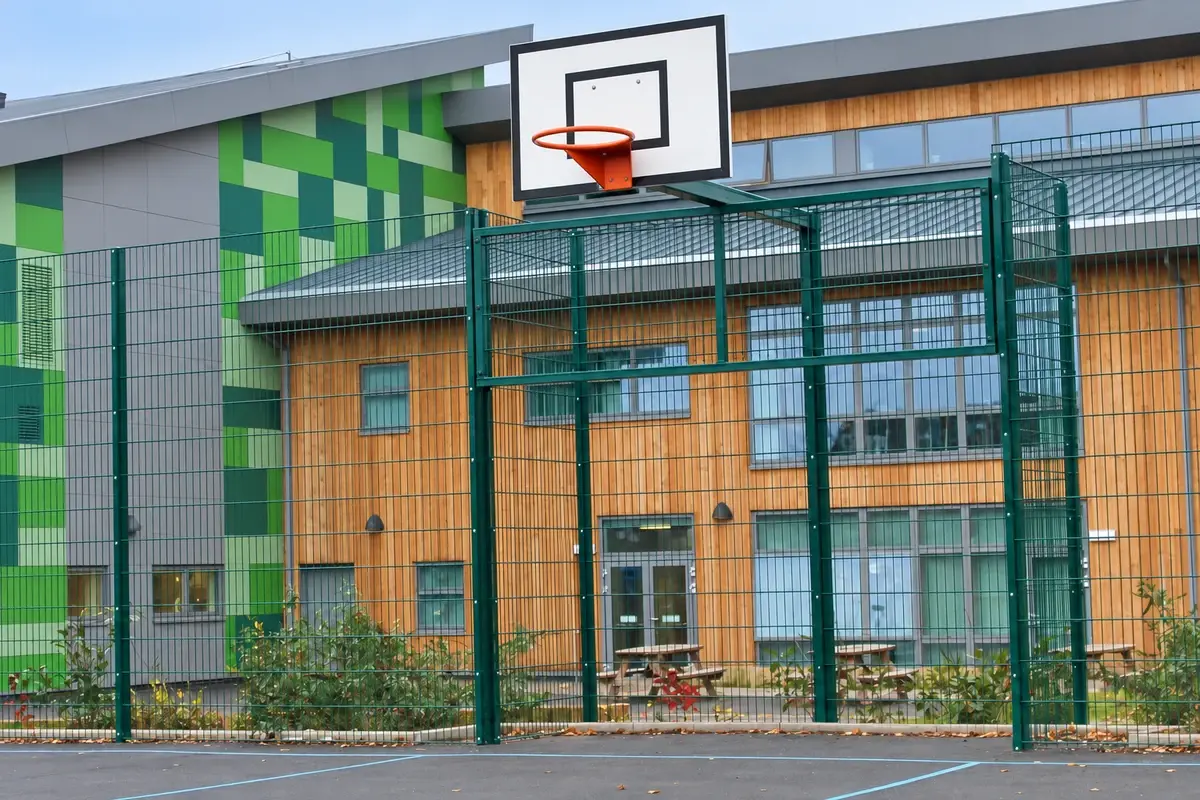
Divide the enclosure into working zones
| Zone | Main duty | Detail to investigate |
|---|---|---|
| Lower contact area | Repeated ball and user contact | Panel construction, connections, edges and replacement access |
| Upper containment | Intercepting balls above the contact zone | Rigid mesh or netting, support and maintenance arrangement |
| Side boundary | Separation and containment appropriate to the sport | Aperture, height and relationship to run-offs |
| Entrance | People and maintenance equipment | Clear opening, flush transitions and safe movement |
| Spectator line | Defined separation from play | Actual barrier duty and any crowd or fall-protection requirements |
The same post may connect two zones, but that does not remove the need to design their joint behaviour. A light net and a rigid rebound panel have different support and maintenance implications.
Calculate the layout before choosing quantities
For an illustrative rectangular enclosure 40 m long and 22 m wide, the perimeter is 2 × (40 + 22) = 124 m. If two gate openings of 3 m and 1.2 m are included within that outline, the remaining fixed-fence length is 119.8 m.
This subtraction is valid only if the perimeter measurement includes the openings. It does not establish the panel count. Post pitch, gate posts, corners and special closing bays determine the final take-off.
Suppose the designer divides the fixed fence into 40 m of a lower rebound arrangement and 79.8 m of another approved boundary arrangement. Keep the two system references separate. A single average price per metre can hide a missing rebound section or a different post requirement.
These dimensions are invented for a quantity example, not a recommended court layout or sport-specific enclosure size.
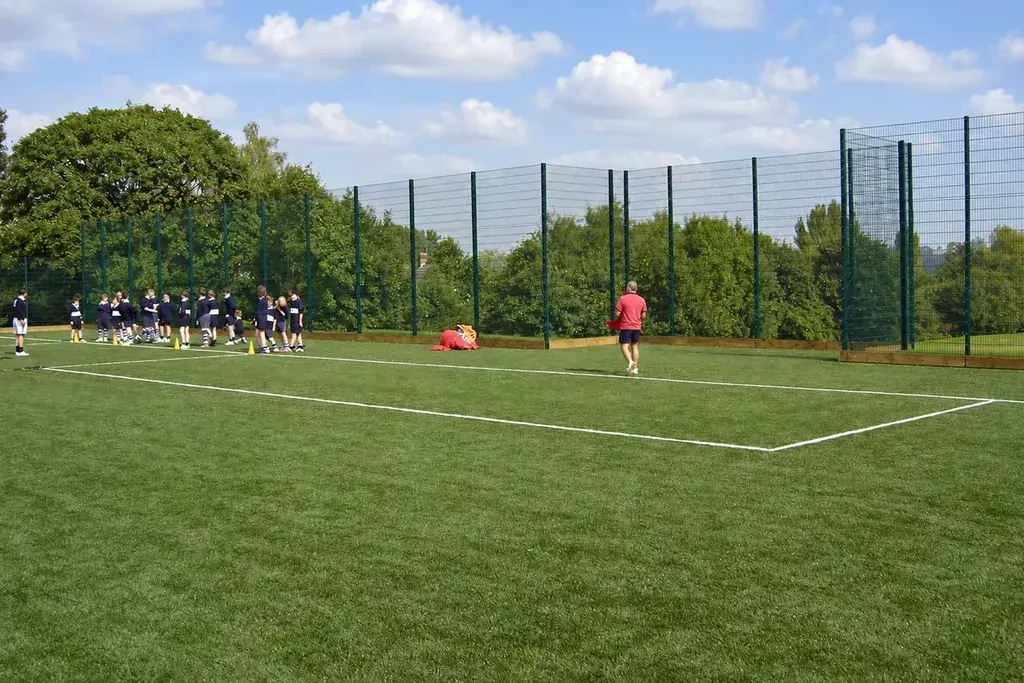
Compare rigid panels and netting on operating behaviour
Rigid panels can provide a defined boundary and, where designed for it, a rebound surface. Flexible netting behaves differently under ball impact and wind and needs an appropriate support, tension and maintenance arrangement. It should not be treated as a interchangeable upper panel because the nominal height matches.
Consider access for inspection and replacement, especially at high level. If a net is to be lowered or removed, the method and storage arrangement belong in the design. Adding netting to existing posts requires review of the changed assembly and loads.
The netting versus rigid mesh comparison develops these trade-offs. Where noise is a concern, separate loose-joint rattle from the wider sound of play; the sports fence noise guide explains that distinction without promising an untested acoustic reduction.
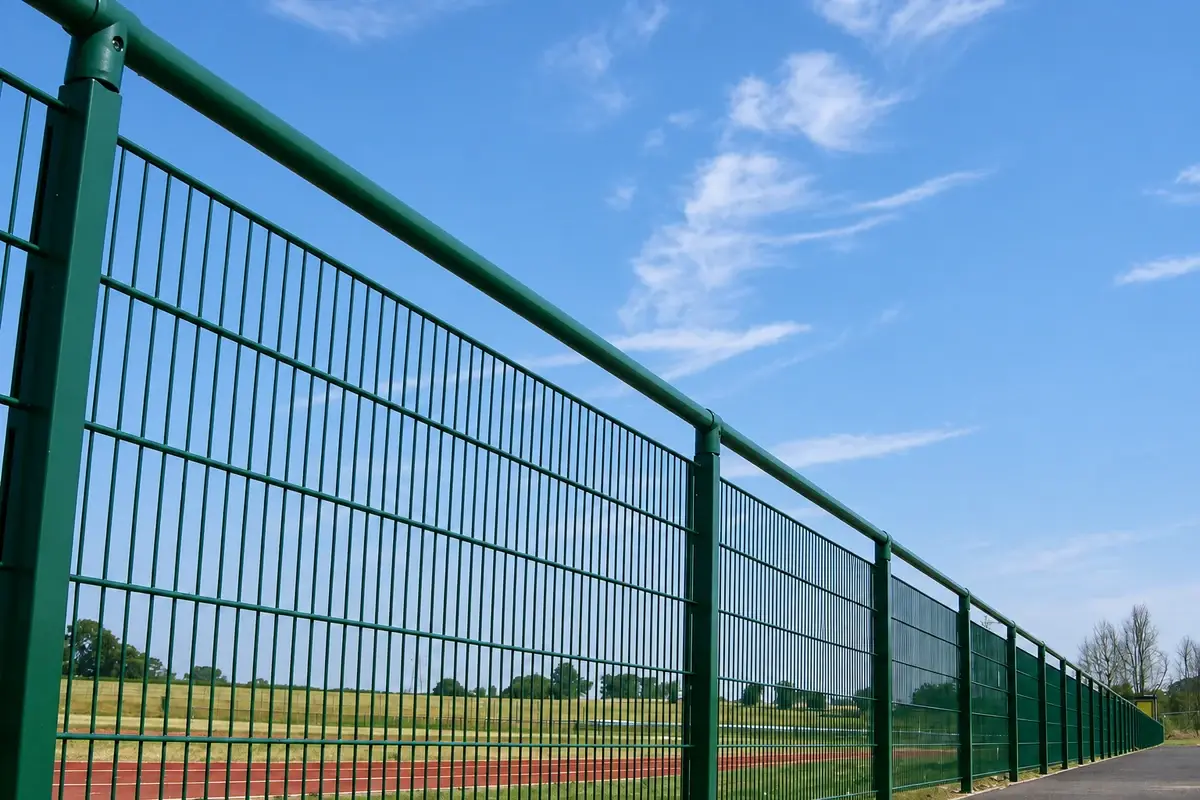
Check the details players encounter
Review accessible edges, lower gaps, projecting fasteners and connections near gates. Corners and changes in height deserve their own drawings. A tidy standard bay does not prove that a cut closing panel or a transition has an acceptable finished edge.
Specify gates that preserve the required boundary in normal use and provide the agreed equipment access. Keep leaf movement and stops outside the required playing and circulation space. A gate used by children or fitted with a closer needs its own complete assessment.
Hand over a maintainable enclosure
The final brief should identify zone references, accepted dimensions, support design, gate arrangements, inspection instructions and replacement parts. Keep the actual installed revisions rather than only the early planning layout.
Use the sports fence inspection method to organise routine observations and repairs. A selection is complete when the facility team can identify which component does which job and how to maintain it, not merely when a panel colour has been chosen.