
Separate material, form and application
Record the core and barb or tape material, coating, supplied form and intended support arrangement. A coil description may refer to concertina deployment, a flat arrangement or another defined product. Those forms are not interchangeable merely because the material is described as razor wire.
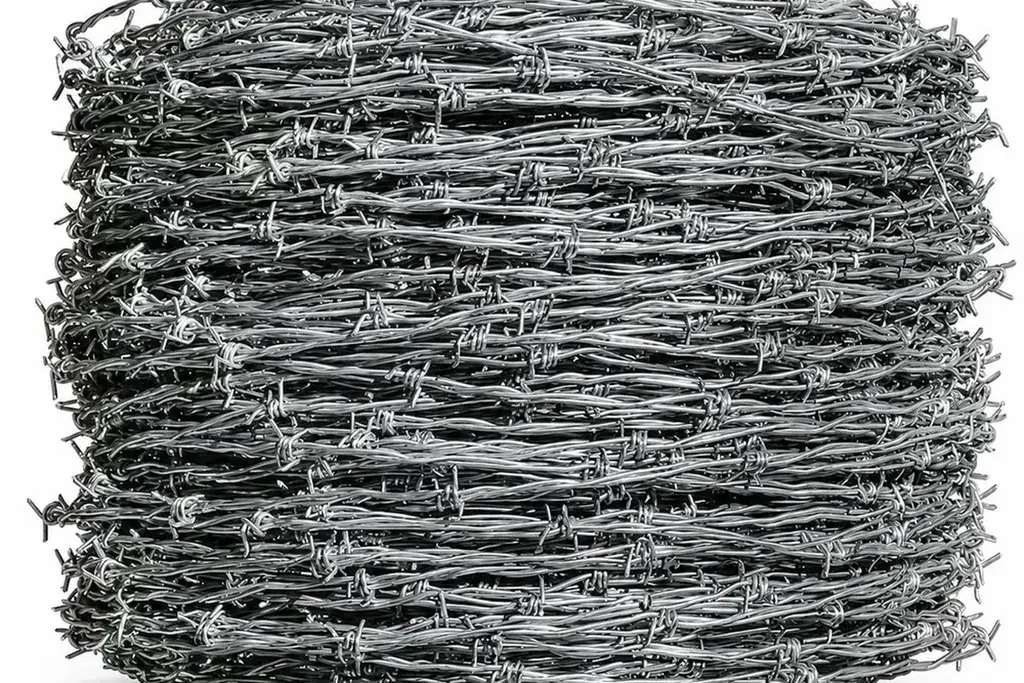
Do not infer a complete security rating from a blade shape, a wire diameter or the product name. The boundary's assessed performance depends on the whole system and its installation. The choice also needs to suit the site, public access and the responsible designer's requirements.
| Purchase field | Barbed-wire example of information needed | Razor-wire example of information needed |
|---|---|---|
| Construction | Line wire and barb arrangement | Core, tape and supplied form |
| Quantity basis | Stated length and pack identity | Stated installed coverage under a defined deployment |
| Support interface | Approved attachment arrangement | Approved support and connection arrangement |
| Evidence | Material and applicable system documents | Material and applicable system documents |
The table describes information fields, not recommended product dimensions.
Compare usable coverage rather than roll count
For an illustrative straight-line quantity exercise, three defined wire lines each following an 80 m run represent 240 m before the specified end and connection allowances. If the approved take-off adds 12 m in total for those details, the scheduled requirement becomes 252 m.
By contrast, the length of tape contained in a coil is not necessarily the linear boundary coverage of that coil. Coverage depends on the specified deployment geometry. Ask the supplier to state installed coverage with its conditions, rather than dividing the boundary length by an undefined roll length.

Do not stretch a coil to a desired length simply to make a quantity work. The product's installation method and support detail determine the permitted arrangement.
Keep the quotation units consistent
Suppose two illustrative offers describe a package at 100 currency units and 130 currency units. If their stated usable coverages under comparable approved arrangements are 8 m and 13 m, the nominal package cost per covered metre is 12.50 and 10.00 respectively.
That arithmetic excludes supports, connections, handling and differences in duty. It cannot establish that the second product is technically preferable. The comparison becomes meaningful only after the proposed arrangements satisfy the same project requirement.
List all excluded parts and activities. A low material price can be offset by different brackets, more difficult handling or an incompatible gate detail.
Review handling and site access as part of the purchase
Specify secure packaging, identification and the installation information supplied with the product. Sharp components need a controlled handling method and appropriate competent installation; a general product comparison is not a safe deployment procedure.
The location also matters. Public approaches, adjacent maintenance work and property limits can rule out an otherwise technically feasible arrangement. Confirm the applicable local restrictions, permissions and any warning-sign requirements with the responsible project adviser before selecting the arrangement.

Separate a coating description from material identity
Ask the supplier to identify the materials of the core and projecting component, not only the colour or general finish. A product described as galvanised can still leave unanswered questions about the particular coating and the components to which it applies. Keep those fields separate on the order.
Compare the material evidence with the package reference supplied. A document for a different wire or tape product does not establish the identity of the shipment. Where the finish or material changes, assess compatibility with the supporting hardware and the intended environment.
Avoid using a mass-per-roll figure to infer all missing dimensions. Weight can help reconcile a defined package, but several constructions may produce similar totals. The reliable purchase description combines the identified construction, material, coverage basis and installation reference, allowing the receiving team to check what arrived without handling the product unnecessarily to guess its specification.
Retain a complete replacement reference
Keep the material, form, coverage basis and support detail together. A later roll described only as razor wire may have a different envelope or deployment arrangement from the original supply.
For the difference between two razor-wire forms, use concertina versus flat wrap. For support geometry, use extension-arm interfaces. Those details turn the purchase into an identifiable system instead of a collection of sharp materials with an assumed level of protection.