
By FencingWise Editorial Team · Updated 17 September 2026.
Each provides useful evidence, but none should be described as all three.
Start with the type of weld being assessed
A resistance-welded wire crossing differs from a fabricated gate-frame joint or a weld between a post and base plate. The specimen, test method and relevant acceptance criteria may therefore differ.
Identify the actual joint on a drawing or photograph. Record wire or member dimensions, material, coating state and the loading direction used in the test. A result from a different joint cannot be transferred simply because both components are part of a fence.
This matters when a supplier provides a general factory report. The report may be genuine and still fail to cover the proposed panel, material or production batch.
Give visual inspection a defined job
A visual inspection can record missing connections, visible cracks, distortion, sharp projections and other surface observations included in the inspection criteria. It can identify where further investigation is needed.
It does not directly measure joint strength. Nor does a photograph establish internal weld quality. The wording should be specific: “no visible crack observed at identified locations” is narrower and more useful than “all welds strong”.
TWI's discussion of resistance spot-weld testing explains the distinction between destructive checks and specialised non-destructive approaches. Its sheet-welding examples do not establish a universal test for fence-wire intersections. The selected method must suit the product.

Review seven fields before accepting a result
| Field | What the buyer should be able to identify |
|---|---|
| Specimen | Panel, joint location and sample reference |
| Material | Wire/member dimensions and relevant material identification |
| Method | Named procedure and applicable version |
| Test arrangement | Grip, loading direction and relevant conditions |
| Results | Individual values, units and reported failure observations |
| Acceptance | Requirement used to judge those results |
| Traceability | Test date, responsible organisation and represented goods |
A report containing a large number in kilonewtons but no test arrangement is difficult to compare with another report. Different loading arrangements can produce different results.
Likewise, a pass mark without the applicable acceptance criterion leaves the reader unable to reconstruct the decision.
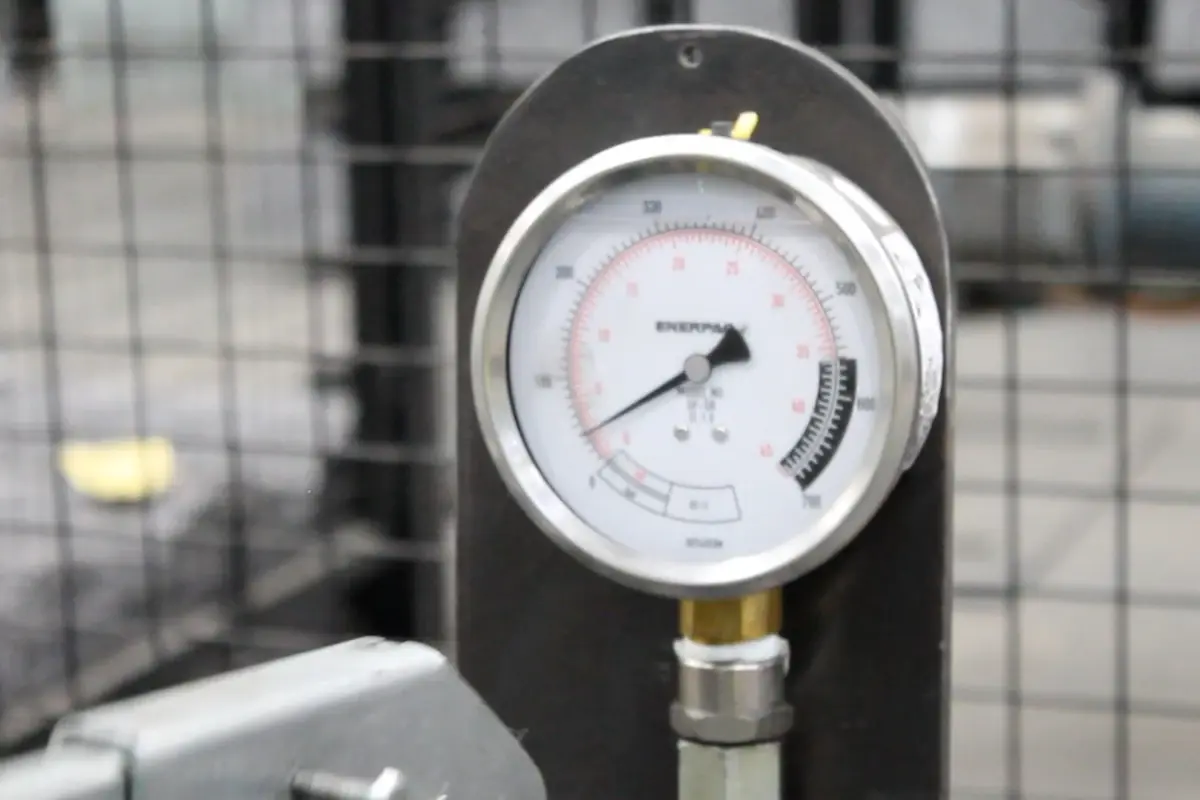
Why the average is not always the acceptance value
Consider a fictional inspection requirement stating that each tested joint must reach at least 2.0 kN under a defined method. Assume three valid results are 2.4, 2.6 and 1.8 kN.
The average is:
(2.4 + 2.6 + 1.8) ÷ 3 = 2.27 kN, rounded.
The average exceeds 2.0 kN, but the third specimen is 0.2 kN below the individual minimum, or 10% below that requirement. Under this hypothetical rule, the set contains a failing result.
The 2.0 kN limit and test values are invented to explain report reading. They are not a FencingWise acceptance criterion, a standard threshold or a security rating. Use the actual method and decision rule specified for the order.
If the real requirement uses a different statistical or characteristic basis, apply that basis rather than substituting the example's minimum rule.
Do not compare force with stress without a conversion basis
Kilonewtons measure force. Megapascals express force per area. A tensile-strength figure for wire and a failure-load figure for a crossing joint are therefore not directly comparable numbers.
A percentage such as “joint strength equals 70% of wire strength” needs its defined denominator, wire area, loading basis and test method. Without them, the percentage can look precise while describing an unclear relationship.
Record the original units and calculation where a ratio is contractually required. Do not reconstruct an acceptance formula from a competitor's marketing table.
A weld result also does not establish a complete fence rating. Panel dimensions, posts, connections, gates and other system details remain outside a single-joint test.
Connect the sample to the production lot
The report should identify how the specimens were selected and which goods they represent. A retained development sample may help validate a process but does not automatically document the current shipment.
Suppose an order has two production lots, A and B, and all tested specimens came from A. The report should not describe B as tested unless the agreed plan and traceability justify that statement. Keep the distinction visible in the release record.
If a failure occurs, define the affected scope, investigation, corrective action and reinspection under the agreed procedure. Replacing the failed specimen with an unrecorded passing one destroys the original evidence.
Ask what changed before requesting another report
Changes in wire source, dimensions, coating state, equipment settings or joint geometry may affect the relevance of previous evidence. The process owner should assess those changes and identify the required verification.
A repeat test should answer a defined question, such as whether an approved corrective process produces acceptable joints in the represented lot. Repeating tests until a favourable number appears is not an adequate decision method.
Keep the initial result, investigation and later evidence together. The buyer can then see how the discrepancy was closed.
Make the evidence request part of the order
Specify required tests, inspection attendance and report contents before production and pricing are finalised. The sample-consistency guide explains how approved samples follow into production, while third-party inspection preparation addresses access and reporting.
FencingWise's confirmed quality process includes checking weld appearance against the order. Additional performance testing must be defined for the actual product and scope. A useful request therefore names the joint, method, acceptance requirement and represented goods, rather than asking for an unspecified “welding certificate”.